My daughter didn't want a production. She wanted to know she'd be ready, and then she wanted to stop thinking about it. That is the whole reason I put together a first period kit for her, and it's why this checklist stays short.
A kit isn't a gift basket or a milestone to perform. It's a small, calm bag that means the first time her period arrives, at home or in the middle of a school day, she has what she needs and doesn't have to ask anyone for it. Below is the first period kit checklist I actually used, what I chose to leave out, and roughly when to put one together. You can build the whole thing in an afternoon for under thirty dollars.
When to make one.
There's no perfect age, only a little earlier than you'd expect. Most girls in the United States get their first period around 12 or 13, and by age 15 nearly all have started, according to ACOG. But it can come sooner, sometimes well before you've had any kind of conversation about it.
So the honest answer is to make the kit before you think you need it. Tuck it in her backpack or her room quietly. The point isn't to mark a day on the calendar. It's that the day, whenever it lands, is already handled.
What goes in a first period kit.
Think of it in two parts: the things she'll actually reach for, and the few small comforts that make the day easier. Keep it to what fits in a pouch she'd be willing to carry.
The essentials
- A handful of pads in a couple of sizes. A few thin ones for light days, and two or three overnight or long pads, because a first period can be heavier than expected and often runs 2 to 7 days.
- One clean pair of underwear, folded small. The single most reassuring thing in the bag.
- A few unscented wipes. Skip anything fragranced, here and everywhere else in the kit.
- A small zip bag or two for wrapping up what's used until she can get to a bin. This is the detail that makes a school bathroom feel manageable.
The comforts
- A stick-on heat patch or a thin warming pad for cramps. Warmth helps, and it's something she can do for herself without making it a thing.
- A plain pain reliever, if your pediatrician is fine with it. Ask first about which one and how much, since dosing depends on her age and weight. This isn't medical advice, just a note to check before you pack it.
- A snack she likes. Small thing, real difference on a rough afternoon.
The bag itself
- An opaque pouch that closes fully and fits her everyday backpack. Not a labeled "period kit," just a pouch. Discretion is the feature.
- A short note from you, only if it suits your kid. Some girls want it. Some would rather you never mention the bag again. You know which one you have.
That's the kit. If you're staring at a longer list online, most of the extra items are there to fill out a product roundup, not because she needs them.
What I chose to leave out.
I didn't pack tampons or a menstrual cup in the first kit. Plenty of teens move to them later, but for a first period, pads are the simplest place to start, and adding options she hasn't been shown how to use just turns a small bag into a decision. She can graduate to the rest when she wants to, on her own timeline.
I also left out anything scented, anything that announced itself as a "milestone," and the urge to over-explain. The kit does its job by being boring. A teenager can spot a parent trying to turn a normal body thing into A Big Moment from across the room, and it rarely lands the way we hope.
For the cramps-and-symptoms question that comes next, I found it more useful to talk through what's normal than to pack a pamphlet. First periods are often irregular for the first couple of years, and that's expected, not a problem to fix. If you want the longer version of that conversation, I wrote about it in a field guide to your first year of tracking. And if you're wondering how much to say versus how much to leave alone, that's most of my short letter to parents.
The one piece that isn't in the bag.
A physical kit handles the first day. The part that comes after is knowing, roughly, when the next one is coming, so it stops being a surprise she has to brace for. That's the only digital thing I'd add, and I'd keep it as quiet as the pouch.
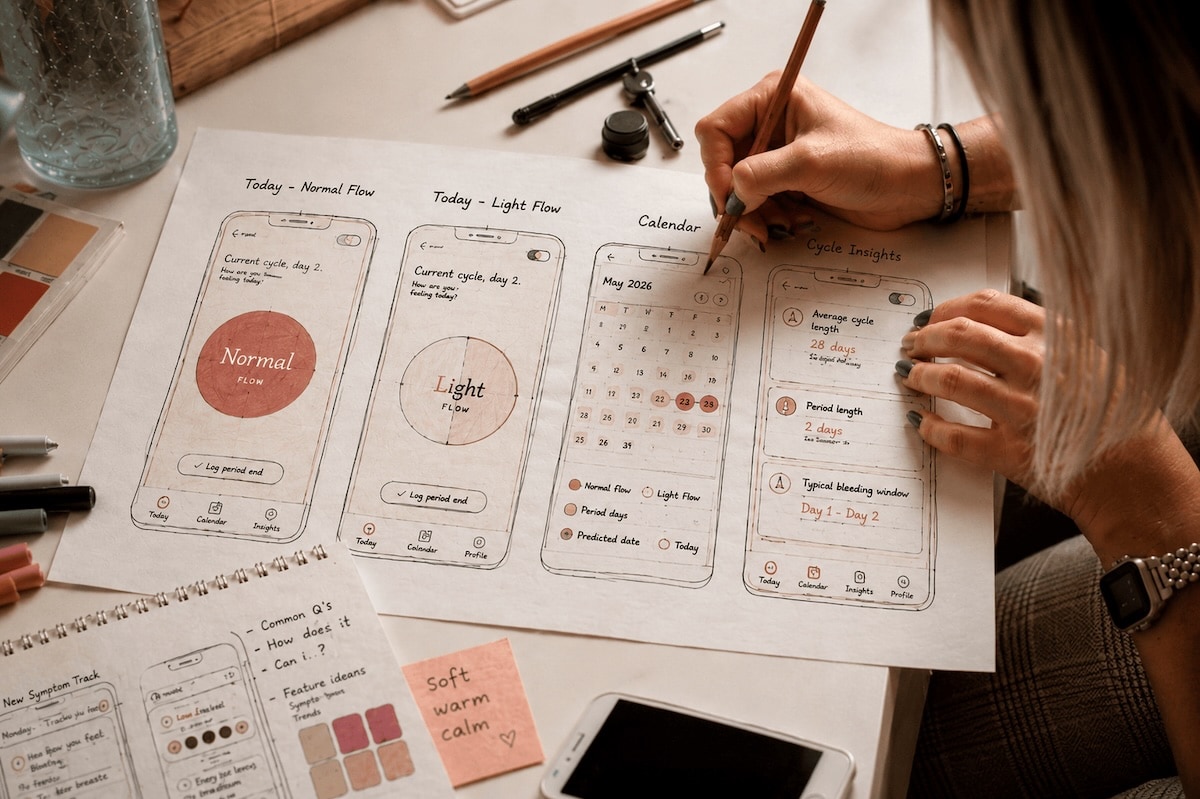
What I didn't want was the obvious version of that: a bright app that asks a 12-year-old for her email, her sex life, and a login before she's logged a single day, then sends all of it to a server she'll never see. For a period tracker. That's the gap my husband and I ended up building TeenCycle to fill, after looking for something simpler for our own daughter and not finding it.
TeenCycle keeps everything on her phone. No account, no email, no cloud, nothing we can read on our end, because there's nothing on our end at all. She taps one circle to log a day, sees roughly when her next period is likely, and closes it. No feed, no push notifications, no streaks to keep. Reminders are optional and stay on her phone. It's the calm, private counterpart to a calm, private bag. You can read why we built it for our own daughter first if you want the longer story.
TeenCycle is on the App Store and Google Play, free to try for 30 days, then $9.99 once. No subscription, no second charge.
One thing to do today.
Build the bag before the conversation feels overdue, not after. Pack the essentials, add one comfort item, choose a pouch she'd actually carry, and put it where she can find it without an announcement. Then tell her, once, where it is and what's in it, and let it sit there quietly until she needs it. Readiness is the gift. The performance isn't.
If you'd like one short, calm piece like this in your inbox each month, no marketing and no tracking pixels, you can subscribe to the journal. One email, unsubscribe in a click.
References & sources
- American College of Obstetricians and Gynecologists (ACOG), The top 3 questions parents ask about their daughters and puberty — average age of first period and the 98%-by-15 figure. acog.org
- American College of Obstetricians and Gynecologists (ACOG), Menstruation in girls and adolescents: using the menstrual cycle as a vital sign — typical bleeding length and early-adolescent irregularity. acog.org
Current as of June 2026. TeenCycle is not a medical device and doesn't replace a doctor. If something about your daughter's cycle feels off, talk to a healthcare provider.