My daughter Mia is a teenager. When she asked for a period app, we did what most parents would do: we opened the app store and looked.
We expected to be done in ten minutes. We weren’t done for weeks.
The free apps were either dated and untrusted or built to collect data we didn’t want anyone collecting about a teenager. The paid apps cost $25 to $150 per year, asked questions that didn’t belong in a young teen’s app, and behaved like social platforms. Feeds, notifications, streaks, "communities," nudges back into the app. None of them felt like they were made for a teen who wanted to log a date and get on with her afternoon.
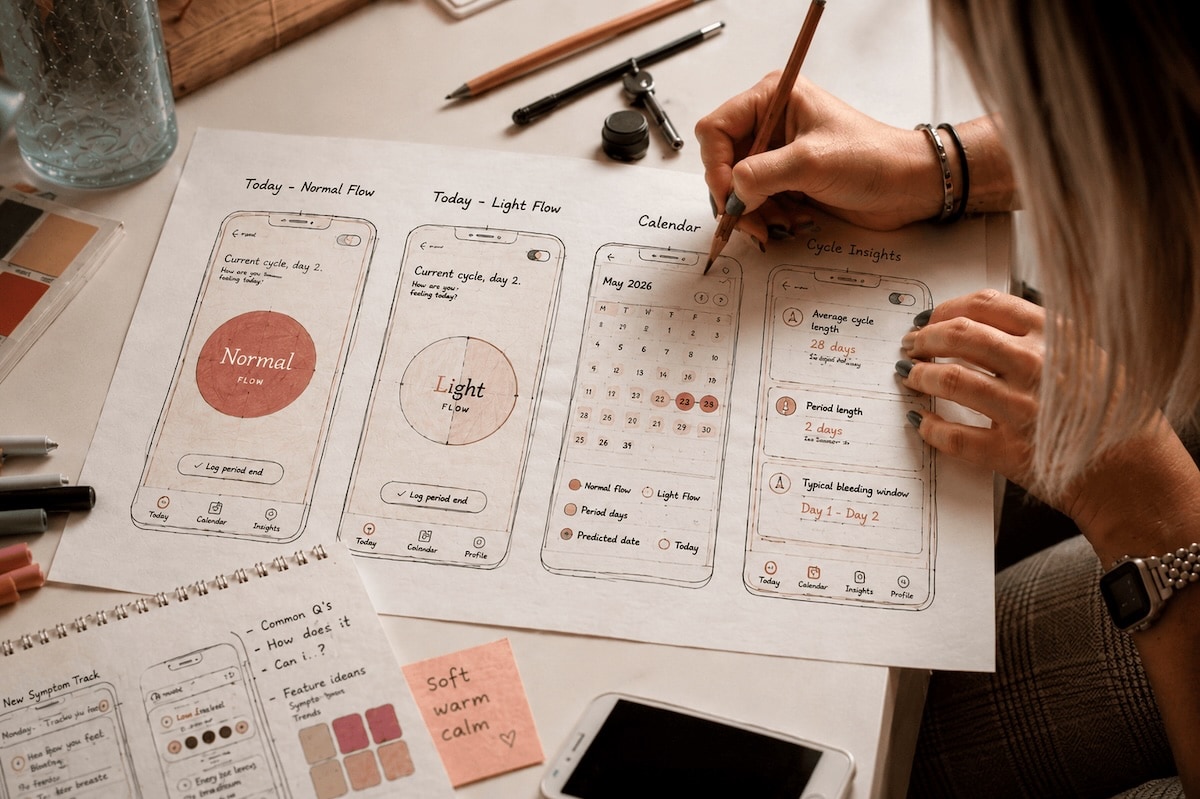
So we built one. Quietly, at the kitchen table, with Mia telling us what to leave out.
This is what came of that, and why.
The apps we tried, in plain terms.
We won’t name them. Each of the popular trackers does some things well, and the founders of those companies are not the villain. The problem is the model. Most period apps are advertising businesses with a tracker on top. A tracker that’s also an ad platform answers to two masters. The user is one of them. The other one is the data buyer.
What we kept running into:
- Accounts. A free tracker that needs an email and a phone number is not a free tracker. It’s a contact-information harvest.
- Sex questions. Several apps asked, on day one, whether the user was sexually active. For an adult that’s a reasonable optional prompt. For a young teenager whose mom is helping her set up an app, it isn’t.
- Notifications. Daily reminders, weekly "insights," prompts to log moods, prompts to log symptoms, prompts to log everything. A teenager doesn’t need a phone that talks to her about her period.
- Subscriptions. $40 to $150 a year, indefinitely. A tracker is a tool, and tools shouldn’t bill you forever.
- Feeds. Some apps had social features: public posts, comments, message boards. None of these belonged anywhere near a teenager’s tracker.
We made a list of every feature that bothered us. Then we made a list of every feature we wanted. The second list was much shorter.
What we chose not to build.
Mia’s contribution to the design was a list of features she didn’t want us to include. She’d watched friends try the popular apps and read the screens. The pattern was the same every time. The app would ask one useful thing, then ten things she didn’t want to answer.
So we wrote down every feature an app in this category typically has, and asked the same question of each one: does this help log a period or predict the next one? Most didn’t. We built the ones that did, and left the rest out: community, AI "insights," habit streaks, push notifications, intimate-activity questions, daily reminders, gamification, in-app ads, third-party trackers, account creation.
The list of what’s not in the app is longer than the list of what is. We’re fine with that.
"I didn’t want an app that wanted to be my friend. I just needed to know when my period was probably coming."
Mia
What’s left.
Three screens.
The first one shows you where you are in your cycle: today’s flow, one prediction, and a place to add a mood or a note. The second is a calendar. Terracotta for days you’ve logged, a paler clay for days the app thinks are likely. The third is settings: a dark mode for late nights, an export button, the privacy promise.
That’s the app. There isn’t a fourth screen because we couldn’t think of one that would help.
Logging a day takes a single tap. Open the app, tap the circle, close the app. The whole interaction is the kind of thing you do while waiting for the kettle.
Private by architecture, not by policy.
Most period apps have privacy policies. We do too. But a policy is a promise. A promise from a company that has your data is only worth as much as the company.
TeenCycle doesn’t have your data, so there’s nothing for us to look at. The data lives on the phone. No account, no cloud, no servers we can read, no backups we can read, no analytics, no tracking pixels, no third-party SDKs. If the phone is off, the data is off.
This was the part I pushed hardest on. I’d spent the previous year reading about period-app class actions and didn’t want a single byte of my daughter’s cycle data anywhere a company could be subpoenaed for it. So we built the app so we wouldn’t have to be subpoenaed for it, by not having it in the first place.
If we can’t see it, we can’t sell it. And we can’t sell what we don’t have.
This is what we mean when we say private by architecture. There is no privacy setting you have to trust us to honor.
One honest price.
TeenCycle is free for 30 days, then $19.99 once. No subscription, no renewals, no second charge. If you buy the app and never open it again, you’ll never hear from us again.
We thought about this part a lot. A subscription would have made the math easier. It would also have meant designing for retention: adding hooks, notifications, and reasons to keep the app open. We didn’t want any of that. The right product for a teenager is one she opens when she needs it and forgets the rest of the time. A subscription model fights that.
So we picked a price that pays for development without trying to live off you forever.
Why we’re telling you this.
You’re probably here because you’re trying to do what we did a year ago: figure out which period app is the right one for your daughter, niece, sister, or yourself. We hope this article is the kind of thing we wish we’d found back then.
If TeenCycle isn’t the right fit, that’s fine. There are some thoughtful apps in the category, and a privacy-minded adult can probably find a setup that works without us. But if you’d like a tracker that doesn’t ask much, doesn’t keep much, and doesn’t charge much, that’s the one we made.
I compared seven apps in our guide to the best period tracker for teens.
Try TeenCycle free for 30 days. If it fits, it’s $19.99, once.
Mia uses it. I use it. The friends Mia’s introduced it to use it. We hope it’s quietly useful to your family too.
Quick answers.
Who made TeenCycle?
Our family. My daughter Mia asked for a period app, none of the ones we tried fit, and we built one at the kitchen table with Mia telling us what to leave out.
Why did you build another period tracker?
The ones we tried wanted an account, asked questions that didn’t belong in a young teen’s app, or charged a subscription. We wanted one that logs a date and shows when the next period is likely.
What does TeenCycle do?
It has three screens. The first shows where she is in her cycle, the second is a calendar, and the third is settings. Logging a day takes one tap.
Where does TeenCycle store data?
On the phone. There is no account, no cloud and no server we can read.
How much does TeenCycle cost?
It is free for 30 days, then $19.99 once. There is no subscription.